Market Structure 001: Institutional Money Flow
Date: 2026-06-27
Series: Financial Notes → Market Structure
Why Learn This?
Stock prices are influenced not only by a company’s financial performance but also by institutional money flow.
Many times, the market rises or falls not because fundamentals have changed, but because large institutions—such as mutual funds, index funds, and market makers—are trading according to predefined rules.
Understanding these money flows helps us understand the source of short-term market movements rather than focusing only on candlestick charts.
Market Context
Recent market discussions have mainly focused on:
- Quarter-end rebalancing
- Index reconstitution
- Dark pool trading
- Semiconductor sector rotation
Many investors believe:
Technical selling pressure may emerge at the end of June, and once these institutional sales are completed, market pressure could ease as July begins.
It is important to note:
This is an analysis of money flows, not a definite prediction of future market performance.
Key Concepts
Dark Pool
Definition
A private trading venue where large institutions execute block trades.
Orders are not displayed publicly in real time, although execution prices are generally based on the public market.
Why Use Dark Pools?
If an institution buys several million shares all at once on the open market, it would quickly push the stock price higher.
To minimize market impact, institutions often execute large trades through dark pools.
Important Note
A dark pool transaction means:
If there is a buyer, there must also be a seller.
Therefore:
Dark pool activity alone does not necessarily indicate that the market will rise.
Selling Pressure
A market condition in which a large number of sell orders continuously push downward on stock prices.
The greater the selling pressure, the harder it becomes for stock prices to rise.
Forced Selling
Selling that occurs because of rule-based or structural requirements rather than investor sentiment.
Common sources include:
- Fund rebalancing
- ETF portfolio adjustments
- Index reconstitution
- Margin calls (to be covered in a future lesson)
These sales are typically not driven by a bearish outlook.
Accumulation
To avoid driving prices higher, institutions often split one large purchase into many smaller orders and gradually build their positions.
This slow process of acquiring shares is called accumulation.
Shares / Position
In the stock market, “chips” (筹码) essentially refer to the shares owned by investors.
“Accumulation” means continuously absorbing shares available in the market.
Sharp Rally / Melt Up
A rapid increase in stock prices over a short period.
It usually indicates that a large amount of capital is flowing into the market.
Why Does Selling Pressure Often Increase at the End of June?
Quarter-End Rebalancing
Many pension funds, mutual funds, and insurance companies maintain fixed asset allocation targets.
For example:
- Stocks: 60%
- Bonds: 40%
If stocks rise too much and exceed the target allocation, the fund will sell some stocks and buy bonds to restore the original allocation.
These trades are driven by portfolio rules, not because the fund is bearish on the market.
Index Reconstitution
When the constituents of an index change, index funds must adjust their holdings accordingly.
For example:
The Russell indexes undergo their annual reconstitution at the end of June, so affected stocks often experience unusually high trading volume.
In contrast:
The S&P 500 and Nasdaq-100 do not have a fixed annual June reconstitution. Their constituent changes occur throughout the year based on decisions made by their respective index committees.
Valuation
P/E Ratio (Price-to-Earnings Ratio)
P/E = Stock Price ÷ Earnings Per Share (EPS)
It represents:
How many times a company’s current earnings investors are willing to pay for its stock.
P/E Ratios for Growth Stocks
Growth stocks generally have:
- Faster revenue growth
- Faster earnings growth
- Higher future expectations
As a result, the market is usually willing to assign them higher P/E ratios.
For growth stocks:
A high P/E ratio does not necessarily mean the stock is overvalued.
The key question is:
Whether future earnings can continue growing.
P/E Ratios for Mature (Value) Companies
Mature companies typically have:
- Slower revenue growth
- Stable earnings growth
- Well-established business models
Therefore:
The market generally assigns them lower P/E ratios.
If a mature company has an unusually high P/E ratio,
investors will often examine:
Whether the company may be overvalued.
Summary
Today’s lesson focused on how institutional money flows influence the market.
Key takeaways:
- A dark pool is simply a trading venue; it does not necessarily signal a bullish market.
- Selling pressure can be driven by either market sentiment or institutional rules.
- Much of the selling at the end of June is related to quarterly portfolio rebalancing.
- P/E ratios should not be compared in isolation—they should be evaluated alongside a company’s growth rate.
- When analyzing market commentary, distinguish between facts, analysis, and predictions.
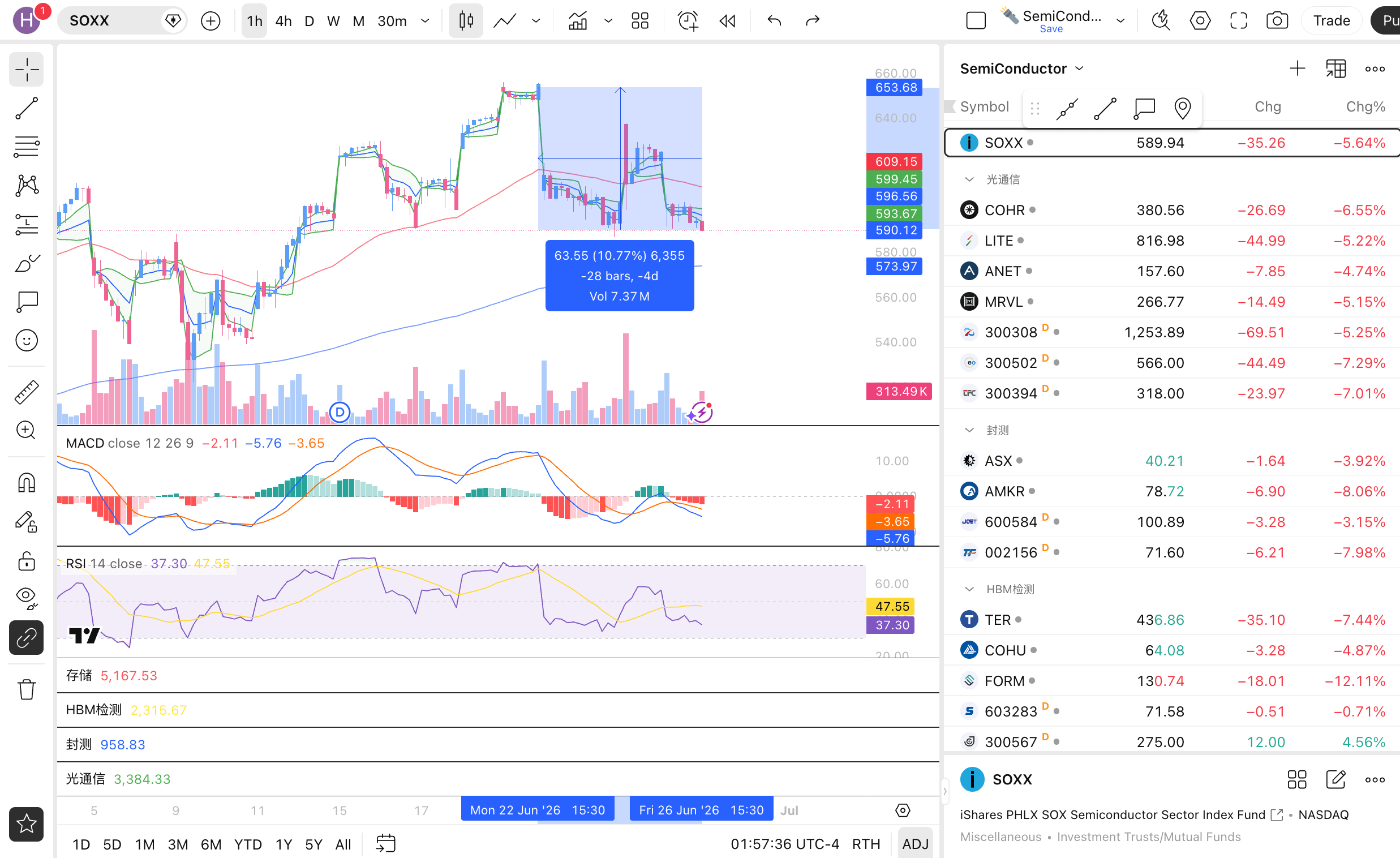
06-26-2026 Semiconductors
Today is Friday, and the market was brutal, with a broad sell-off across the board.
Semiconductor stocks had recently regained some upward momentum, but then gave it all back.
On 06-03, AVGO released its earnings. The results beat Wall Street’s expectations, but not by as much as some had hoped. The stock plunged from 500 to 380, and has now fallen further to 360. For a moment, it felt like the internet bubble was about to burst.
During this period, semiconductor stocks rose and fell repeatedly, like a small boat tossed about in the wind. Everyone was hoping for some positive news to keep the boat afloat.
On 06-24, MU reported earnings that massively exceeded Wall Street’s expectations, stunning the market. It lifted semiconductor stock prices once again.
Now, at the end of June, everything has returned to square one. The sector has gone quiet again.
Planning to buy SOXX call options on Monday.